Most agency owners don’t wake up wondering whether they should outsource.
They wake up wondering:
- How do I scale without hiring?
- How do I increase margins without sacrificing quality?
- How do I take on larger clients without expanding payroll?
- How do I protect client relationships while expanding service delivery?
That’s where the conversation around traditional outsourcing and white label partnerships begins.
According to industry research, companies continue to outsource primarily to reduce costs and increase operational flexibility. But for growing digital agencies, the real question isn’t whether to outsource—it’s how to do it without creating delivery bottlenecks, quality issues, or brand risks.
Understanding the difference between traditional outsourcing and white label partnerships can help agency leaders choose the right growth model for long-term profitability.
What Is Traditional Outsourcing?
Traditional outsourcing is a vendor-based relationship where an agency hires an external company, freelancer, or contractor to complete specific tasks or projects.
The outsourced team operates independently and focuses on fulfilling deliverables rather than becoming part of your agency’s processes, systems, or long-term growth strategy.
Common examples include:
- Outsourcing website development projects
- Hiring freelance SEO specialists
- Contracting PPC management services
- Using external content writers
Traditional outsourcing can provide short-term capacity and lower labor costs. However, agency owners often face challenges around communication, consistency, accountability, and maintaining service quality across multiple vendors.
What Is a White Label Partnership?
A white label partnership operates differently.
Instead of hiring a vendor to complete isolated tasks, you gain access to a dedicated team that functions as an extension of your agency.
Think of it as building additional delivery capacity without building additional headcount.
A white label team can include:
- SEO specialists
- Web developers
- Designers
- PPC experts
- Content strategists
- Marketing operations specialists
Clients see your agency’s brand, while the white label team delivers behind the scenes using your processes, standards, and workflows.
The goal isn’t simply fulfillment.
The goal is scalable growth.
White Label Partnerships Work Best When:
- You want to expand service offerings
- Hiring internally is expensive or slow
- You need predictable delivery capacity
- You want to improve profit margins
- You need operational scalability
The strongest white label partnerships become integrated members of your delivery team rather than external vendors.
What is a Virtual White Label Remote Team?
Consider it the ghostwriting of design, development, and digital marketing.
In this business model, you hire a highly skilled and experienced team of designers, developers, SEOs, and marketers that works as an extension of your in-house team. They work with you instead of working for you, becoming your partners in success.
Needless to say, white labeling is flexible, scalable, and easily brandable. That’s why it is fast becoming popular.
Traditional Outsourcing Vs Virtual White Label Remote Team
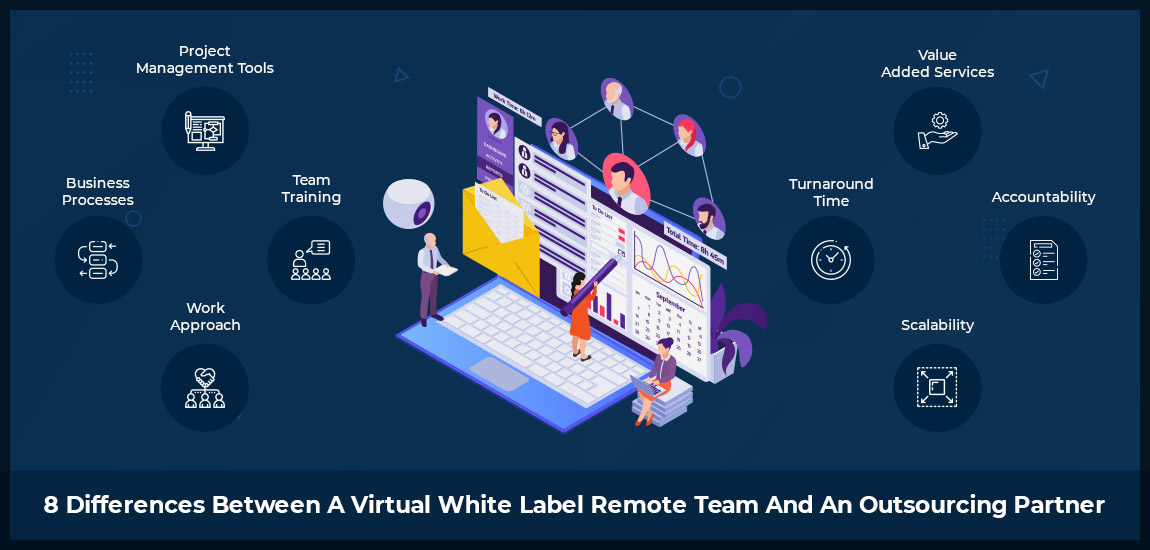
Let’s look at eight key differences between traditional outsourcing and hiring a virtual white label remote team.
1. Project Management Tools
Outsourcing your projects comes with considerable risk. You are quite literally putting the future of your digital agency in someone else’s hands.
For most digital agency owners, the biggest concern is real-time project management. It enables you to control project timelines and work quality and use your resources with maximum efficiency. That is why project management tools are at the heart of outsourcing.
In traditional outsourcing, your partner will most likely restrict you to a particular project management tool or a legacy system.
It poses two main obstacles:
- First, you need to train your in-house team to use the project management tool. And this could take weeks, especially if you’ve never used it before. Most agencies don’t have time for this.
- Second, if it’s a legacy system, you may not get all the features you want. For example, if it lacks built-in real-time communication, you will have to turn to another application. Using multiple tools is time-consuming, not to mention expensive.
However, a virtual white label remote team lets you choose a project management tool. Or you can mutually decide which application you can use. In our experience, managing everyday tasks becomes a lot easier if both parties are on the same page from day one.
2. Business Processes
It is difficult to implement traditional outsourcing because most outsourcing companies are reluctant to embrace new business processes. The absence of a functional and flexible business process is often a leading cause of outsourcing failure.
In a typical outsourcing arrangement, the vendor wants to make money while the client is looking for better services. This is where things get a little tricky. Implementing a new business process is time-consuming, costly, and needs more resources. So, your vendor/partner is less likely to change their work processes to meet your growing business needs.
Generally speaking, a white label team tends to be highly adaptive. If anything, adaptability is the bedrock of a successful white label partnership. A professional white label digital agency understands that each brand/client has unique business needs and requires a customized approach.
Your white label remote team will not only develop a new business process but also modify it as the scope of responsibilities expands. In fact, at E2M, we make it a point to address this concern right out the gate.
That’s something traditional outsourcing fails to deliver.
3. Team Training
In the beginning, long-term outsourcing was the industry norm. These contracts spanned for as long as ten years. However, long-term outsourcing soon lost its charm, with clients moving to short-term contracts. Short-term outsourcing is cost-effective, flexible, and less time-consuming. Most importantly, it keeps you from locking into a long-term commitment, precisely what most digital agency owners want.
However, this comes with a significant drawback. When it comes to outsourcing, training the team just for one or two projects is often a waste of time. Moreover, not all outsourcing companies will be willing to welcome your approach, especially for short-term projects. This is a major headache for your account managers.
On the other hand, a virtual white label remote team usually requires one-time training, being already technically well-versed. You only have to get them acquainted with your work process, coding standards, and SOPs. Once done, you can hire the team for as long as you want, be it a few weeks, months, or a year.
Most agencies like E2M offer fixed-cost monthly plans. It is like the Netflix of white-label web design and development. You can discontinue anytime and rehire the team without the pain of training them again. It is a highly cost-competitive and practical approach.
4. Work Approach
It is rare to stumble across an outsourcing company that focuses on long-term business growth. With cost-saving at the core of this business model, the work approach often revolves around project-specific quick fixes.
Saving money is great, right?
Not so much.
It delivers nothing except cost savings. If you want to grow your brand and gain a competitive edge, traditional outsourcing is likely to disappoint.
You will need a partner that understands your brand voice and helps you stand apart from your competitors. That, in turn, requires a personalized approach, which is where a virtual white label remote team comes in.
White label digital agencies go for a personalized approach that pays in the long run. They are more of a long-term investment than a quick fix. As a result, you can develop SOPs, coding standards, and business goals focused on brand growth, not just profit margin.
Is there a more cost-effective and productive way to contract out?
5. Value Added Services
Who wouldn’t like a cherry on top?
Unfortunately, that is seldom the case when it comes to traditional outsourcing. The focus is on getting maximum work done in a limited time frame and low cost. Of course, that helps you save money. But your work quality also takes a hit, bigtime!
Inconsistent work quality can cause more harm than good to your business. it can turn your most loyal customers away, probably forever. If you want to grow your business and build your brand, traditional outsourcing is not the way.
On the other hand, a white label team adds value to your work. For example, at E2M, we are constantly honing our skills and staying on top of the latest industry trends. If you partner with someone like us, you can leverage the best-in-class technologies and hands-on knowledge.
In short, a virtual white label remote team always goes the extra mile!
Traditional outsourcing is less likely to offer this advantage.
6. Scalability
Unlike traditional outsourcing, white label partnership is naturally scalable. For starters, a virtual white label remote team brings a wide range of skills and real-life experience to the table. Plus, most agencies like E2M keep expanding their talent pool constantly.
In traditional outsourcing, you enter a small sphere of skills and experience. Your growth remains restricted to only selected services.
Not to sound like a broken record, but a virtual white label remote team helps expand your bandwidth. You can tap into digital services you never thought of months ago. For instance, a WordPress development agency can expand into Shopify development or content marketing in a matter of days, if not weeks.
Plus, if one of the remote team members is sick or unavailable, there’s always someone to cover for them. And if you need more resources, your white label partner can assign skilled team members at a moment’s notice.
Can you get this level of scalability anywhere else?
7. Turnaround Time
Another difference between the two is the turnaround time. As a digital agency owner, you probably know the importance of never missing deadlines. Your clients would want every task delivered on time. Should there be a delay, they expect you to communicate it in advance.
This is where a virtual white label remote team sets itself apart from traditional outsourcing. Your white label team is mindful of not missing delivery deadlines. They also have well-established communication and project management processes in place. If there is a delay or an issue, you will get informed as soon as possible.
White label digital agencies usually don’t struggle with problems, such as lack of skills, resources, or technology, which improves your time to market. However, traditional outsourcing may not always offer optimum performance in this regard.
8. Accountability
As a digital agency owner, your biggest concern would be accountability. Digital outsourcing is often complex. It involves multiple areas of accountability, ranging from defining end-user experiences to the tech stack you want to use. Without ensuring accountability, you will face disputes down the line, resulting in missing deadlines and poor work quality.
You have to understand that accountability is a shared responsibility. Instead of a hands-off arrangement, you need a jointly approved plan to keep tabs on various key metrics.
You will need your service provider to”
- Make some decisions independently.
- Coordinate with your customers as your partner.
Unfortunately, your outsourcing partner may not offer this advantage. Most traditional outsourcing companies stick to their business processes, development standards, and security benchmarks.
On the other hand, a virtual white label remote team works with you instead of working for you.
- They can be your equals in decision-making.
- You may even benefit from their extensive industry experience and skills.
- Plus, as you use the same project management tool, you are up-to-date with real-time developments virtually 24/7.
That said, like E2M, most white label digital agencies also provide a dedicated point of contact and a host of communication channels to stay in touch. This takes accountability a step further.
Traditional Outsourcing vs White Label: Which Is Right for Your Agency?
Choose traditional outsourcing if:
- You need occasional project support
- Cost is the primary consideration
- Long-term integration isn’t necessary
Choose a white label partnership if:
- You’re focused on agency growth
- You want predictable delivery quality
- You need scalable capacity
- You want to protect client relationships
- You aim to increase margins while expanding services
For most growth-stage agencies, the decision isn’t about outsourcing versus hiring.
It’s about creating a scalable operating model that allows the agency to grow without constantly adding overhead.
That’s why many agencies eventually move from traditional outsourcing to white label partnerships as they mature
In Conclusion
In today’s world, outsourcing is probably the best way to run a successful, highly profitable, and agile digital agency. But whether to go for traditional outsourcing or hire a virtual white label remote team is a dilemma that still haunts many agency owners. Hopefully, these eight differences will help you understand that hiring a virtual white label remote team is the best option. In fact, it is the future of outsourcing.
If you are ready to hire a virtual white label remote team or need more information, give us a call now.